Last updated: May 10, 2026
- The 7 Wastes of Lean Manufacturing: A Practitioner's Guide with Real Industry Examples
- Why Eliminating Waste Is the Fastest Path to Profitability
- The 7 Wastes of Lean (Muda); Explained with Factory Floor Examples
- The TIMWOOD(S) Acronym, How to Never Forget the 7 Wastes
- How to Spot Wastes in Your Facility (VSM + Gemba Walk Method)
- Real-World Case Study: 30% Cycle Time Reduction in 12 Weeks
- Frequently Asked Questions
- Key Takeaways
📊 Industry Data
A study by the Lean Enterprise Institute found that Lean transformations reduce manufacturing lead times by an average of 50% within the first 12 months.
Research by Industry Week shows that companies sustaining Lean practices for 3+ years outperform industry peers by 2–3x on productivity growth.
The 7 Wastes of Lean Manufacturing: A Practitioner’s Guide with Real Industry Examples
Every manufacturing facility wastes more than it realizes. Not through carelessness, through invisibility. The losses are built into the way work has always been done, accepted as normal because they have never been named.
Taiichi Ohno, the Toyota engineer who created the Toyota Production System, gave us the vocabulary to name them: the seven wastes, or Muda in Japanese. Once you learn to see them, you cannot unsee them. And once you start eliminating them, the impact on productivity, cost, and quality is often faster and larger than anyone expected.
I have spent 23 years on production floors, and I still find new examples of these seven wastes in every facility I visit. They are universal. What changes is which ones dominate and how severely.
Why Eliminating Waste Is the Fastest Path to Profitability
Lean’s foundational premise is straightforward: in any production process, only a small fraction of activities actually add value from the customer’s perspective. Everything else, every movement, every wait, every rework cycle, every unit produced before it is needed, is waste.
Ohno estimated that in most manufacturing operations, only 5 to 10% of activities are genuinely value-adding, a finding consistently supported by modern lean research. The rest is waste in varying degrees of visibility.
This is not an accusation against the people doing the work. It is a statement about the system they work within. People work hard in organizations full of waste; they are just working hard on the wrong things, or on necessary evils created by a system that was never designed for flow.
Eliminating waste means two things: reducing costs without cutting corners, and freeing up capacity that was already being paid for. In most cases, a sustained waste-elimination program pays for itself within the first year.
The 7 Wastes of Lean (Muda); Explained with Factory Floor Examples
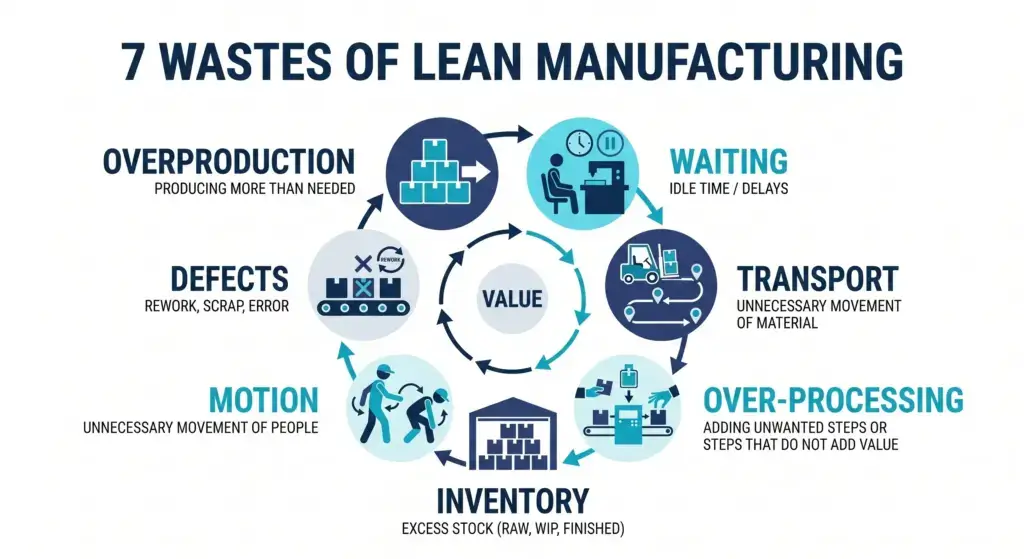
1. Overproduction: The Mother of All Wastes
Definition: Producing more than the customer needs, faster than the customer needs it, or earlier than the customer needs it.
Ohno considered overproduction the most dangerous waste because it generates and amplifies every other waste. When you produce too much, too early, you need somewhere to put it (inventory). You need to move it (transport). It may develop quality problems while sitting (defects). And the capital tied up in unsold stock cannot be used elsewhere.
Real example: In a high-volume stamping operation I worked with, the press team consistently operated at full capacity regardless of downstream demand, motivated by a performance KPI that measured press output rather than line output. The result was 3 to 4 days of work-in-progress inventory piling up between the press and the next operation, hiding quality issues, causing handling damage, and creating a false sense of productivity.
How to identify it: Walk the floor and look for accumulations of finished or semi-finished goods that are not immediately needed downstream. Check your production schedule against actual customer orders.
Root solution: Produce to takt time, not to machine capacity. Pull systems (kanban) and one-piece flow eliminate the conditions that make overproduction feel necessary.
2. Waiting: The Invisible Time Thief
Definition: Any time operators, machines, or materials are idle, waiting for the next step, for information, for parts, or for a decision.
Waiting is the most visible waste on the surface but the least attacked in practice. It is often accepted as “normal” because it is passive, nobody is actively doing something wrong, the line just… stops. Or the operator stands. Or the material sits.
Real example: In an assembly operation, operators regularly waited 8 to 12 minutes per shift for engineering to approve first-off parts before the line could start. The approval process required the quality engineer to physically walk to the station. A simple visual standard with go/no-go gauges eliminated 90% of those waits without reducing quality assurance.
How to identify it: Observe a production shift for 2 hours without intervening. Note every moment when an operator is not actively working on a value-adding task. Time it. The total will surprise you.
Root solution: One-piece flow eliminates batch-induced waiting. Standardized work eliminates waiting caused by unclear processes. Andon systems and immediate-response protocols reduce waiting caused by escalation delays.
3. Unnecessary Transport
Definition: Moving materials, parts, or products between locations when that movement adds no value to the product.
Transport is necessary in most manufacturing processes; materials must move from receiving, through processing, to shipping. But unnecessary transport is any movement that could be eliminated, reduced, or shortened through better layout or process design.
Real example: In a subassembly area, finished components were moved from the assembly cell to a staging area 40 meters away, stored, then retrieved and moved to the main line 25 meters in the opposite direction. The staging area existed because of a historical scheduling mismatch that had since been resolved. The extra 65-meter round trip occurred dozens of times per shift, totaling over 3 km of unnecessary movement daily.
How to identify it: Draw a spaghetti diagram, follow a single part from raw material to finished goods, and trace every physical move on a floor plan. The resulting diagram usually looks exactly as its name suggests.
Root solution: Cell layout design and value stream mapping clearly reveal transport waste. The solution is usually a combination of layout changes and the implementation of a pull system to align production timing with downstream consumption.
4. Over-Processing: Doing More Than the Customer Needs
Definition: Performing more work, more steps, or using more resources than what the customer actually requires and values.
Over-processing is the trickiest waste to spot because the extra work often looks like quality or care. Deburring parts to a finish tolerance tighter than the specification. Painting surfaces the customer will never see. Running triple inspections where a single verification is sufficient. Generating reports nobody reads.
Real example: A machining operation was applying a surface finish of Ra 0.8 μm to all parts in a family, even those where the drawing specified Ra 1.6 μm. The tighter finish required an additional grinding pass on every part, adding cycle time, tool wear, and energy cost for a quality dimension the customer had never required, and the drawing had never mandated.
How to identify it: For every step in your process, ask: “Would the customer pay extra if they knew we did this?” If the answer is no, examine whether the step is genuinely necessary or a legacy of over-engineering.
Root solution: Review specifications critically against actual customer requirements. Challenge process steps that exist “because we’ve always done it this way” without a documented quality rationale.
5. Excess Inventory
Definition: Any inventory beyond the immediate minimum needed to keep the process flowing, raw materials, work-in-progress, or finished goods.
Inventory is often seen as a safety buffer, a hedge against uncertainty. In lean thinking, it is viewed differently: as the evidence of an unstable system. Inventory hides problems. Behind every large buffer is a problem that has not yet been forced to the surface and solved.
Real example: A component manufacturer held 18 days of raw material inventory “just in case” of supplier delivery issues. The same supplier delivered late twice in a year. When the team calculated the carrying cost of those 18 days, floor space, capital tied up, handling, and obsolescence risk, the true cost of the buffer far exceeded the cost of a formal supplier development program that could have reduced delivery uncertainty to near zero.
How to identify it: Walk through your facility and look at everything that is not being actively worked on. Count it. Calculate the value tied up in it. Then ask how many days of production it represents.
Root solution: Pull systems are designed to set maximum inventory limits. Supplier development reduces incoming material uncertainty. SMED reduces the batch sizes that make large inventories feel necessary.
6. Unnecessary Motion
Definition: Any physical movement by an operator that does not directly add value, such as reaching, walking, bending, searching, or turning.
Motion waste differs from transport waste. Transport is about material movement. Motion is about people’s movement. An operator who spends 6 minutes per shift walking to a storage rack to retrieve tools that should be at arm’s reach has lost 25 hours of productive time per year, per operator.
Real example: At a manual assembly station, the operator had to pivot 180 degrees, reach behind them to retrieve the next subcomponent from a cart, then pivot back to the assembly jig. A workstation redesign that positioned the cart in front of the operator at the correct ergonomic height, with angled presentation for easy part pickup, reduced cycle time by 8 seconds per unit and eliminated a repetitive motion that had contributed to two musculoskeletal reports in the previous year.
How to identify it: Watch an operator through one full cycle. Note every movement that does not directly involve the product being assembled or transformed. Time the non-value-adding movements specifically.
Root solution: 5S is the primary tool; a proper place for everything, at the point of use, at the right height and angle. Ergonomic workstation design and standardized work layouts are the engineering solutions.
7. Defects and Rework
Definition: Any product that does not meet specification, requiring rework, repair, reinspection, or scrapping.
Defects are the most visible waste and the one most actively measured. Yet their true cost is almost always underestimated. The cost is not just the scrap value of the material. It includes the machine time used to produce the defective part, the operator time to detect and sort it, the rework time, the reinspection cost, and, for defects that reach the customer, the warranty cost, the claim management cost, and the reputational damage. Every defective part also directly reduces your Overall Equipment Effectiveness (OEE); quality is one of the three multiplying factors in the formula.
Real example: A welding cell was producing parts with a 3.2% internal rejection rate on a critical dimension. The parts were detected during end-of-line inspection and sent to a dedicated rework station. The rework station employed two full-time operators, consumed additional materials and energy, and still resulted in a 12% downgrade rate of reworked parts. When the actual cost of the 3.2% defect rate was calculated, including all downstream costs, it exceeded €180,000 annually per cell.
How to identify it: Calculate your First Pass Yield (FPY); the percentage of parts that pass every inspection point the first time without any rework. If you do not know your FPY, start measuring it today.
Root solution: Defect elimination requires root cause analysis (5 Whys, 8D), process standardization, and mistake-proofing (Poka-Yoke), designing processes where producing a defect becomes physically difficult or impossible. Defect elimination and corrective action are also core requirements of ISO 9001:2015 (Clause 10.2), making waste reduction a direct lever for quality system compliance.
📥 Get the Free 7 Wastes Observation Checklist
Enter your name and email below, and I’ll send the PDF to your inbox within 1 minute. Print it, take it to the floor, and start identifying waste today.
🔒 No spam. Unsubscribe anytime.
The TIMWOOD(S) Acronym, How to Never Forget the 7 Wastes
Memory tools matter in practice. When you are walking a production floor with a team, you need the framework readily accessible, without having to look it up.
The acronym TIMWOOD (or TIMWOODS when including the 8th waste of under-utilised talent) gives you:
| Letter | Waste |
|---|---|
| T | Transport |
| I | Inventory |
| M | Motion |
| W | Waiting |
| O | Overproduction |
| O | Over-processing |
| D | Defects |
| S | Skills (8th waste: under-utilised talent) |
The 8th waste (unused talent and skills) was added by Western lean practitioners and is not part of Ohno’s original seven, as documented in Toyota Production System: Beyond Large-Scale Production (1988). It captures the loss from not involving operators in problem-solving and improvement, which is a genuine and significant waste. However, it is worth distinguishing from the original model when teaching the framework.
How to Spot Wastes in Your Facility (VSM + Gemba Walk Method)
Identifying wastes is not a theoretical exercise. It requires going to the GEMBA (the actual place where work happens) and observing with fresh eyes.
Step 1: Prepare a simple observation checklist. List the 7 wastes with space to note specific examples, locations, and rough time or frequency estimates.
Step 2: Walk the full value stream. Do not observe a single workstation in isolation. Follow one product family from raw material receipt to finished goods despatch. Watch the material, not the machines.
Step 3: Observe without intervening. Resist the urge to fix things as you observe them. Your goal is understanding the current state completely before taking any action.
Step 4: Involve the operators. The people who do the work every day know exactly where the frustrations, workarounds, and abnormalities are. Ask them. “What gets in your way?” “What would you change if you could?” The answers contain your improvement backlog.
Step 5: Quantify the top 3 wastes. Not every waste deserves equal attention. Identify the two or three that are most significant in terms of frequency or cost, and focus your initial improvement energy there.
A formal Value Stream Map (VSM) takes this observation process further by mapping the complete information and material flows, calculating value-added versus non-value-added time, and revealing systemic patterns that a simple Gemba Walk might miss.
Real-World Case Study: 30% Cycle Time Reduction in 12 Weeks
A Tier 1 automotive component supplier producing stamped and welded subassemblies was experiencing chronic delivery performance issues. On-time delivery to the OEM was running at 82%, well below the contractual 98% requirement.
An initial Gemba Walk and VSM exercise revealed that the dominant wastes were not where management expected them.
What was expected: Machine downtime (Defects/Availability). What was found: A combination of Waiting (8.5% of production time lost waiting for first-off approvals and in-process inspections), Overproduction (2.5 days of WIP inventory between presses and welding), and Unnecessary Motion (operators averaging 14 metres of unnecessary travel per cycle to retrieve tooling from a shared cabinet).
Actions taken over 12 weeks:
- First-off approval process redesigned with go/no-go standards and operator self-verification, eliminating 80% of quality hold time
- Kanban system installed between press and weld operations, capping WIP at 4 hours maximum
- Workstation redesigned with shadow boards at point of use for all tooling
Results:
- Cycle time reduced by 31% without any capital investment in new equipment
- WIP inventory reduced from 2.5 days to 4 hours
- On-time delivery improved from 82% to 96% within the 12-week window
The lesson: the biggest opportunities for improvement are almost never where you think they are before you look properly.
Frequently Asked Questions
Key Takeaways
- The 7 wastes (TIMWOOD) are Ohno’s framework for making non-value-adding activities visible and attackable.
- Overproduction is the most dangerous waste; it creates and amplifies all others.
- Use TIMWOOD as a Gemba Walk checklist. Observation is the starting point.
- Quantify your top 3 wastes before acting. Not all wastes deserve equal attention.
- The biggest opportunities for improvement are rarely where management expects to find them. If you want an objective view of which wastes are costing your facility the most, a structured diagnostic is the fastest path to a prioritized action plan.
- Waste elimination does not require capital investment; it requires seeing the system clearly. McKinsey research consistently shows that lean waste reduction delivers faster ROI than capital expenditure programs.
Do you recognize these wastes in your facility? Let’s talk about a Flash Diagnostic: 2 days on-site, a written report, and a prioritized action plan.