
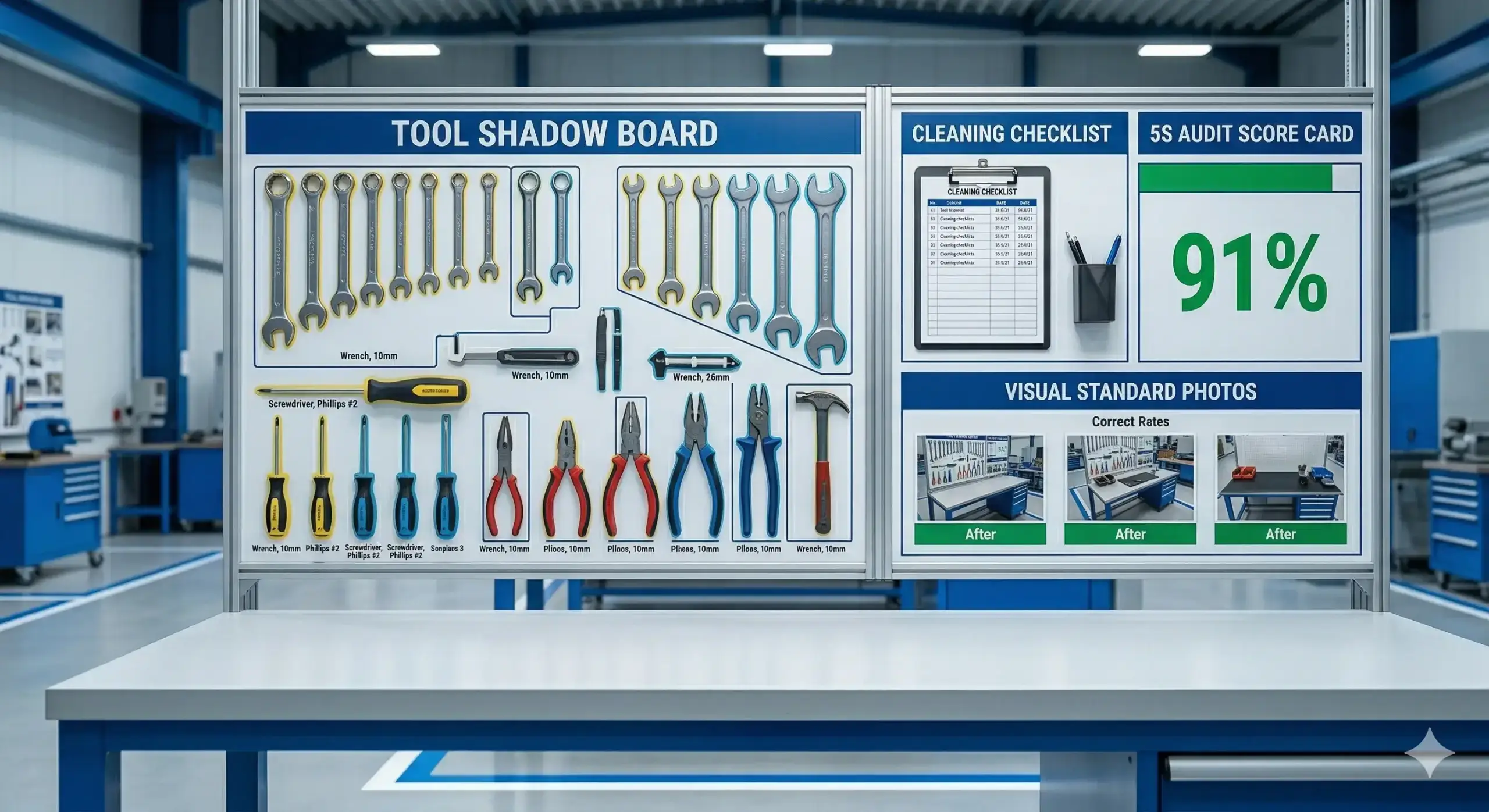
A Step-by-Step Guide for Production Managers
Most production managers know what 5S is. Few know how to actually implement it and make it stick.
The problem isn’t knowledge. It’s execution. 5S workshops get launched with enthusiasm, deliver visible results in week one, then slowly fade back into old habits by month two.
After implementing 5S in dozens of industrial facilities across automotive and manufacturing environments, I’ve developed a proven 30-day roadmap that delivers lasting results.
Here’s exactly how to do it.
What Is 5S and Why Does It Matter?
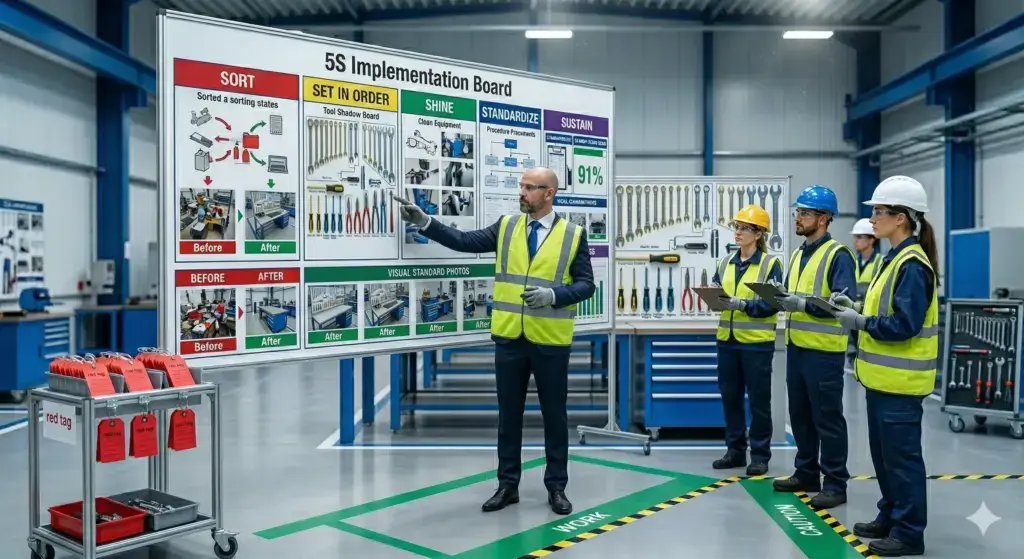
5S is a Lean methodology originating from Japan, built on 5 principles:
🔵 Sort (Seiri): Remove everything unnecessary
🔵 Set in Order (Seiton): A place for everything
🔵 Shine (Seiso): Clean and inspect daily
🔵 Standardize (Seiketsu): Create visual standards
🔵 Sustain (Shitsuke): Make it a daily habit
When implemented correctly, 5S delivers:
✅ 10-25% productivity improvement
✅ Significant reduction in search time for tools
✅ Improved safety and reduced accident risk
✅ Higher product quality through visual control
✅ A culture of discipline and continuous improvement
Week 1: Sort (Days 1-7)
Day 1-2: Launch and alignment
- Brief all team leaders and operators on the 5S vision and expected results
- Define the scope: start with ONE area, not the entire facility
- Take before photos of every zone
Day 3-5: Red tag campaign
- Place a red tag on every item whose necessity is unclear or disputed
- Categories: Keep, Move, Remove, Dispose
- Do not remove anything yet: tag first, decide later
Day 6-7: Red tag review
- Hold a 30-minute red tag review meeting with team leaders
- Make final decisions on every tagged item
- Remove, relocate or dispose of items decided
✅ Week 1 result: A workspace containing only what is truly needed
Week 2: Set in Order (Days 8-14)
Day 8-9: Define locations
- Assign a specific, logical location for every remaining item
- Apply the 30-second rule: every tool must be reachable in under 30 seconds
- Involve operators: they know the workflow best than anyone else
Day 10-12: Visual marking
- Apply floor tape to define zones, walkways and storage areas
- Create shadow boards for tools and equipment
- Label every shelf, drawer and storage location
- Use color coding: red for safety, yellow for caution, green for operational
Day 13-14: Documentation
- Photograph every organized zone
- Create a zone layout map
- Post visual standards at each workstation
✅ Week 2 result: A workspace where everything has a clearly defined, visible home
Week 3: Shine & Standardize (Days 15-21)
Day 15-17: Deep clean
- Conduct a full facility cleaning: machines, floors, walls, equipment
- While cleaning, inspect for defects, leaks, wear and damage
- Create a cleaning defect log and assign corrective actions
Day 18-19: Cleaning standards
- Define WHO cleans WHAT, HOW and HOW OFTEN
- Create simple one-page cleaning checklists for each zone
- Assign zone ownership to specific operators
Day 20-21: Visual standards
- Create before/after photo standards for each zone
- Post cleaning schedules visibly in each area
- Define the minimum acceptable standard with clear visual examples
✅ Week 3 result: A clean, inspected workspace with clear ownership and visual standards
Week 4: Sustain (Days 22-30)
Day 22-24: 5S audit system
- Create a simple 5S audit checklist: maximum 20 questions, scored 0-5
- Train team leaders to conduct weekly 5S audits
- Post audit scores visibly in each zone
Day 25-27: Daily routines
- Implement a 5-minute end-of-shift 5S routine for all operators
- Add 5S as a standing agenda item in daily team meetings
- Establish a weekly 5S walk with management
Day 28-30: Review and celebrate
- Conduct the first official 5S audit
- Compare before and after photos with the entire team
- Recognize and celebrate improvements publicly
- Define the 90-day improvement targets
✅ Week 4 result: A self-sustaining 5S system with daily routines, audit process, and team ownership
The 3 Reasons 5S Fails
Even with a solid plan, 5S implementations fail for predictable reasons:
- Starting too big:
Trying to implement 5S everywhere at once guarantees failure. Always start with one pilot area, prove the concept, then expand. - No management presence:
If managers don’t walk the floor, ask 5S questions, and hold standards, operators will revert within weeks. Leadership visibility is non-negotiable. - No audit system:
Without a regular, scored audit process, 5S becomes invisible. What gets measured gets managed. Always.
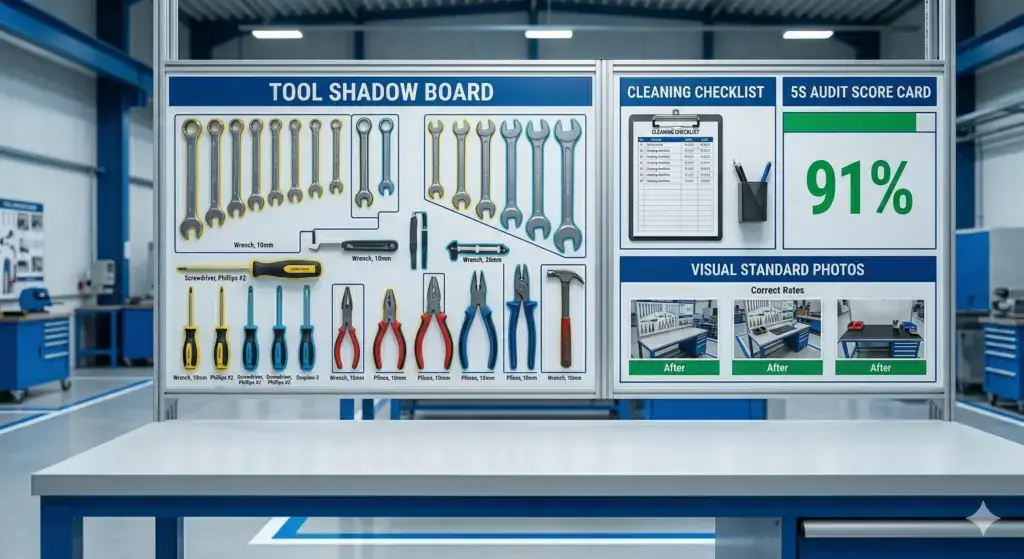
Your 30-Day 5S Action Plan
Week 1: Sort: Remove the unnecessary
Week 2: Set in Order: Define every location
Week 3: Shine & Standardize: Clean and document
Week 4: Sustain: Build the daily habit
30 days. One area. Full commitment. The results will speak for themselves.
Need Help Implementing 5S in Your Facility?
I’ve helped industrial teams across Belgium and Europe implement 5S from scratch, achieving audit scores above 85% within 90 days.
If you want a structured, expert-led 5S implementation that actually sticks, let’s have a conversation.
No obligation. Just results.