
Introduction
Every minute a machine sits idle during a changeover is a minute of capacity permanently lost. In many plants, changeovers last 30, 60, or even 90 minutes, often without anyone questioning whether that time is necessary.
📊 Industry Data
Research by Industry Week shows that companies sustaining Lean practices for 3+ years outperform industry peers by 2–3x on productivity growth.
A study by the Lean Enterprise Institute found that Lean transformations reduce manufacturing lead times by an average of 50% within the first 12 months.
SMED (Single Minute Exchange of Die) is a lean methodology that systematically reduces changeover time, often by 50% to 75%, without capital investment. It is one of the highest-return improvement initiatives available to any manufacturing operation.
What Is SMED and Where It Comes From
SMED stands for Single Minute Exchange of Die. The goal is to reduce any machine changeover time to under 10 minutes, single-digit minutes. The method was developed by Shigeo Shingo, a Japanese industrial engineer, as part of the Toyota Production System in the 1950s and 1960s.
Originally applied to stamping press die changes at Toyota and Mitsubishi, SMED principles have since been adopted in injection molding, food production, pharmaceutical packaging, CNC machining, and virtually any process with changeovers.
Why Long Changeovers Are a Hidden Cost
The direct cost of changeover time is obvious: lost production. But the indirect costs are often larger:
- Large batch sizes to justify long changeovers, leading to excess inventory
- Reduced flexibility to respond to customer demand changes
- Pressure to run the same product longer than needed, creating overproduction
- Operator stress and quality errors at startup after a rushed changeover
Internal vs. External Setup Activities
The core concept of SMED is distinguishing between 2 types of setup activities:
- Internal setup: Activities that can only be performed while the machine is stopped. Example: removing the old die, installing the new die, adjusting clamps.
- External setup: Activities that can be performed while the machine is still running. Example: gathering tools and materials, preparing the next die on a cart, pre-heating a mold.
In most plants, 30% to 50% of internal setup time is actually external work being done with the machine stopped unnecessarily. SMED converts this internal time to external time.
The 4 Steps of SMED Implementation
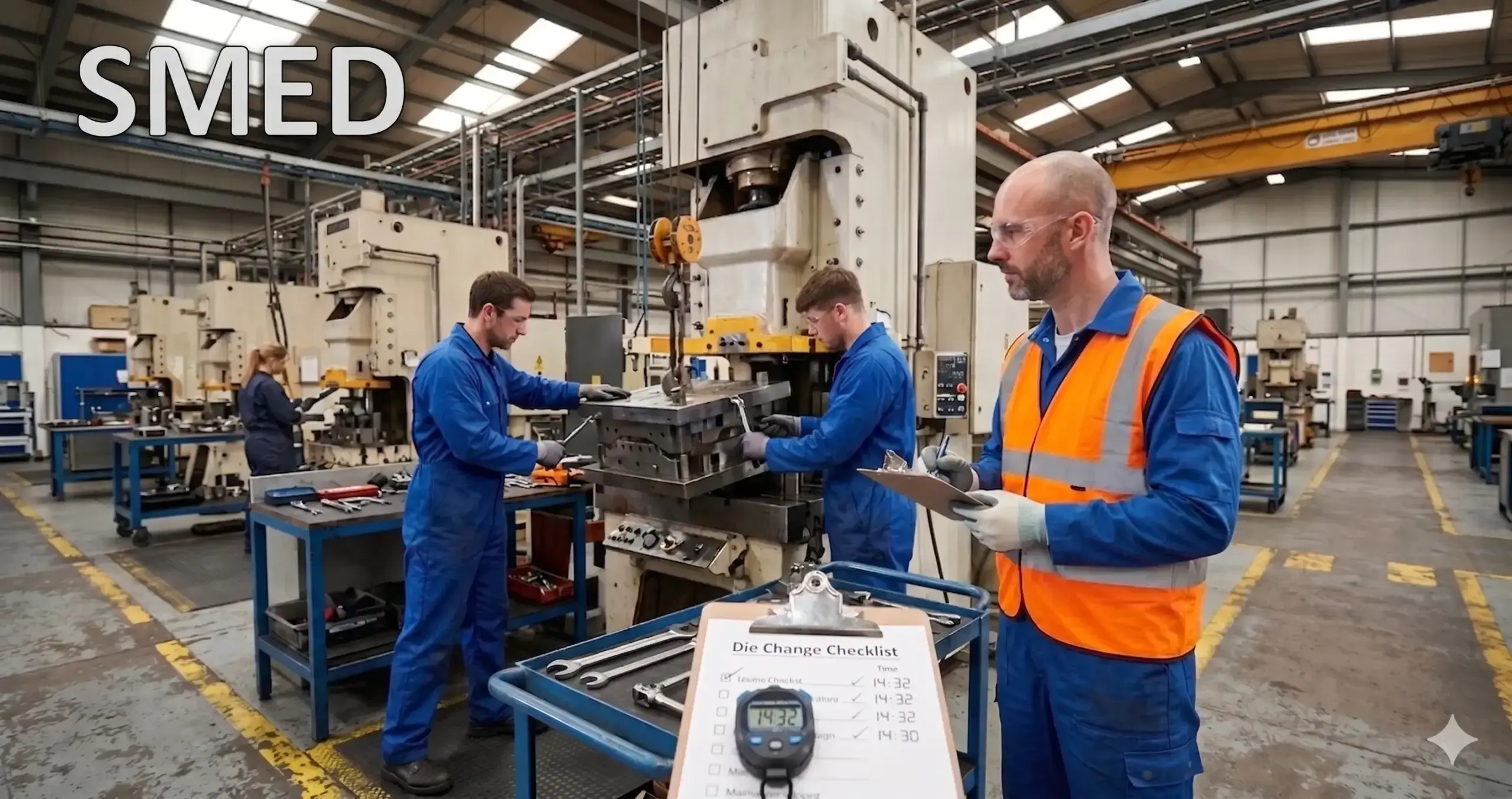
Step 1: Document the current changeover: Record a full changeover video and time each activity. Be precise and non-judgmental. You need to see reality, not what people think should happen.
Step 2: Separate internal and external activities: Review the video with the team. Classify every activity as internal or external. This step alone typically reveals 20-30% of potential time savings.
Step 3: Convert internal to external: Ask: Why does this activity have to be done with the machine stopped? For each internal activity, find ways to prepare, pre-position, or pre-adjust before the machine stops.
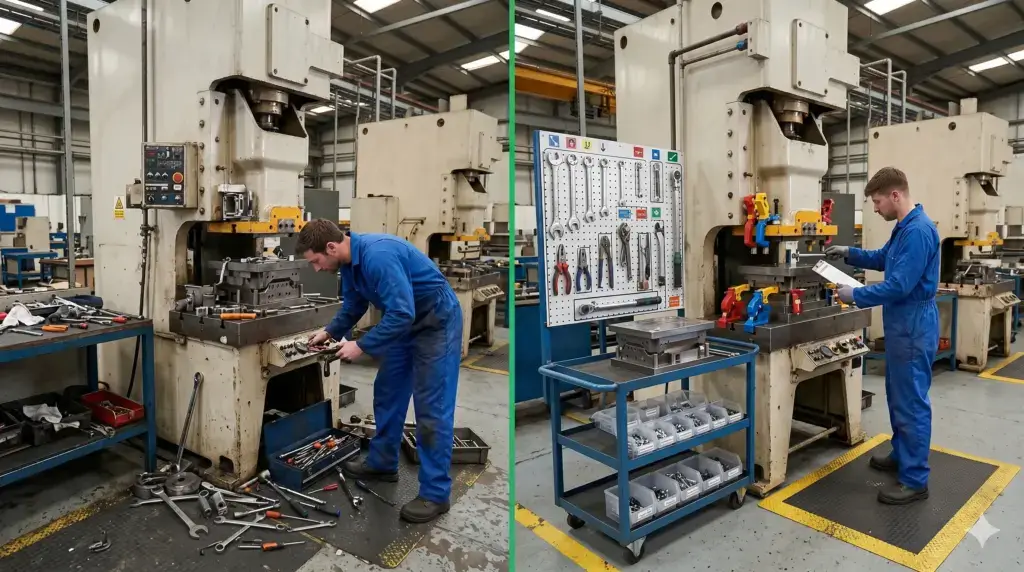
Step 4: Streamline all activities: For the remaining internal activities, reduce required time through standardization, quick-release clamps, color-coding, shadow boards, and single-bolt fastening.
SMED in Practice: Real Industry Examples
Stamping plant: A press changeover that took 4 hours was reduced to 38 minutes using SMED. The team created a dedicated changeover cart, replaced 40 bolts with quick-release clamps, and standardized die height across all dies.
Food production: A packaging line changeover between product formats was reduced from 52 minutes to 14 minutes. Pre-kitted format parts, a changeover checklist, and a two-person standard work routine drove the improvement.
Injection molding: Mold change time was reduced from 75 to 19 minutes by pre-heating molds off-machine, implementing crane pre-positioning, and standardizing mold clamping systems.
Linking SMED to Lean and OEE Improvement
SMED directly improves OEE Availability by reducing planned downtime from changeovers. It also enables smaller batch sizes (improved flow), lower inventory levels, and faster response to customer demand, core goals of lean manufacturing.
A 50% reduction in changeover time typically translates to a 5-15 point increase in OEE, depending on changeover frequency.
Common SMED Mistakes to Avoid
Mistake 1: Accepting internal activities without questioning them: Every internal step should be challenged. The default assumption should be that it can be converted to an external format.
Mistake 2: Improving only the longest activities: Address all activities systematically, not just the most obvious ones. Small reductions across 20 activities add up quickly.
Mistake 3: Not standardizing the result: A successful SMED event must produce a new standard work document. Without standardization, changeover time drifts back to the original within weeks.
Conclusion
SMED transforms changeover from a necessary evil into a competitive advantage. Plants that can change over in 10 minutes instead of 60 can run smaller batches, hold less inventory, and respond to customer requirements faster than their competitors.
Start by videoing one changeover. The waste will be immediately visible.