- 7 KPIs Every Production Manager Must Track to Stay in Control
- KPI 1: Overall Equipment Effectiveness (OEE)
- KPI 2: First Pass Yield (FPY)
- KPI 3: On-Time Delivery (OTD)
- KPI 4: Changeover Time
- KPI 5: Absenteeism Rate
- KPI 6: Safety Incident Rate
- KPI 7: Cost of Poor Quality (COPQ)
- How to Build Your KPI Dashboard
- Need Help Building Your KPI System?
7 KPIs Every Production Manager Must Track to Stay in Control
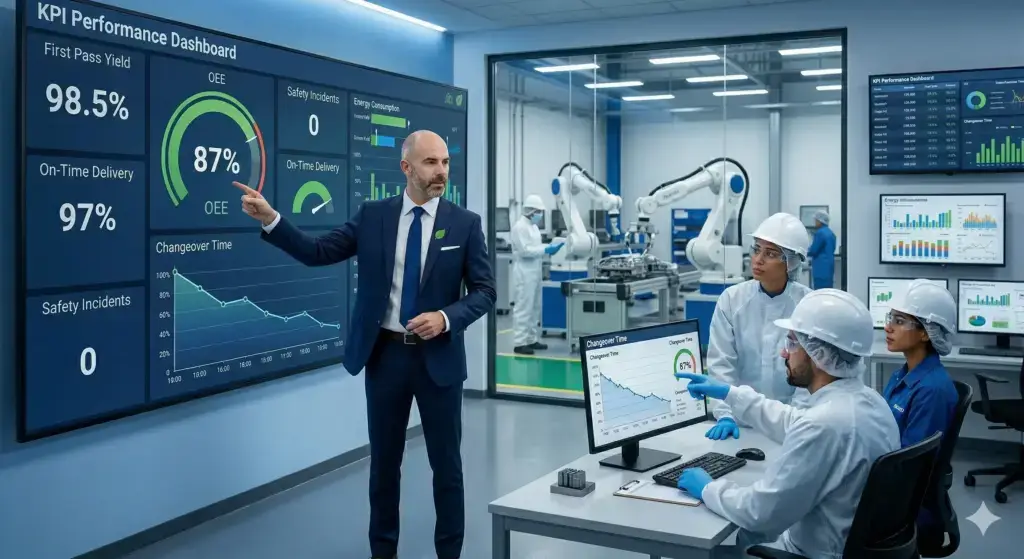
You cannot manage what you cannot measure! This is one of the oldest principles in operations management and one of the most consistently ignored.
Following my experience in production, managers are making critical decisions based on intuition, experience, and gut feelings, while the data that would make those decisions 10 times more accurate sits uncollected on the shop floor.
After 23+ years in production management and leadership, I’ve identified the 7 KPIs every production manager must track, not quarterly or monthly, but daily.
Here they are:
KPI 1: Overall Equipment Effectiveness (OEE)
What it measures:
The percentage of planned production time that is truly productive.
Formula:
OEE = Availability × Performance × Quality
World class benchmark: 85%
Industry average: 60%
Why it matters:
- OEE is the single most powerful indicator of production efficiency.
- It captures losses from downtime, reduced speed, and quality defects in a single number.
How to use it:
- Track daily.
- Investigate any day below the target.
- Decompose into its three components to identify whether the problem is. Availability, performance, or quality.
KPI 2: First Pass Yield (FPY)
What it measures:
The percentage of products that pass quality inspection without any rework or rejection on the first attempt.
Formula:
FPY = (Units passing first inspection ÷ Total units produced) × 100
World class benchmark: 99%+
Warning level: Below 95%
Why it matters:
- Every unit that requires rework represents wasted labor, material, and machine time.
- Low FPY is a direct signal of process instability or insufficient quality controls.
How to use it:
- Track by production line and by shift.
- Identify patterns. If FPY consistently drops on the night shift, you have a training or supervision gap to address.
KPI 3: On-Time Delivery (OTD)
What it measures:
The percentage of customer orders delivered on or before the promised date.
Formula:
OTD = (Orders delivered on time ÷ Total orders) × 100
World class benchmark: 98%+
Critical threshold: Below 90%
Why it matters:
- On-time delivery is the ultimate test of whether your production system is in control.
- It integrates planning, scheduling, production performance, and quality into one customer-facing metric.
How to use it:
Track weekly. When OTD drops, trace back to the root cause. Was it a planning failure? a production disruption or a quality problem?
KPI 4: Changeover Time
What it measures:
The time elapsed between the last good unit of one product and the first good unit of the next product.
Target: Depends on industry and product mix.
Focus: Trend reduction over time.
Why it matters:
- Changeover time directly determines your production flexibility.
- Long changeover times force large batch sizes, increase inventory, and reduce responsiveness to customer demand.
How to use it:
- Track every changeover.
- Apply the SMED methodology to systematically reduce time.
- Celebrate improvements publicly; changeover reduction is one of the fastest wins in Lean manufacturing.
KPI 5: Absenteeism Rate
What it measures:
The percentage of scheduled work time lost to unplanned absences.
Formula:
Absenteeism = (Hours absent ÷ Hours scheduled) × 100
Benchmark: Below 3%
Warning level: Above 5%
Why it matters:
- High absenteeism is rarely just an HR problem.
- It is a signal of deeper issues, poor working conditions, low engagement, physical strain, or a toxic team environment.
How to use it:
- Track monthly by team and shift.
- High absenteeism in a specific area should trigger a deeper investigation into working conditions and team dynamics.
KPI 6: Safety Incident Rate
What it measures:
The number of recordable safety incidents per 100 full-time workers per year.
Formula:
Incident Rate = (Number of incidents × 200,000) ÷ Total hours worked
World-class benchmark: Below 1.0
Target: Zero lost-time incidents
Why it matters:
- Safety performance is not just a moral and legal obligation.
- High incident rates drive up insurance costs, reduce productivity, damage morale and attract regulatory scrutiny.
How to use it:
Track monthly. Also, track near-miss reports; a high near-miss reporting rate is a positive sign of safety culture, not a negative one.
KPI 7: Cost of Poor Quality (COPQ)
What it measures:
The total cost incurred due to producing, finding, fixing or avoiding defects.
Components:
- Internal failure costs: scrap, rework, downtime
- External failure costs: returns, warranties, customer complaints
- Appraisal costs: inspection, testing
- Prevention costs: training, process improvement
Benchmark: Best-in-class below 5% of revenue
Industry average: 10-30% of revenue
Why it matters:
- COPQ reveals the true financial impact of quality problems.
- Most organizations dramatically underestimate this number and are shocked when they calculate it for the first time.
How to use it:
- Calculate quarterly.
- Use it to build the business case for quality improvement investments.
- A COPQ of €500,000/year justifies significant investment in prevention.
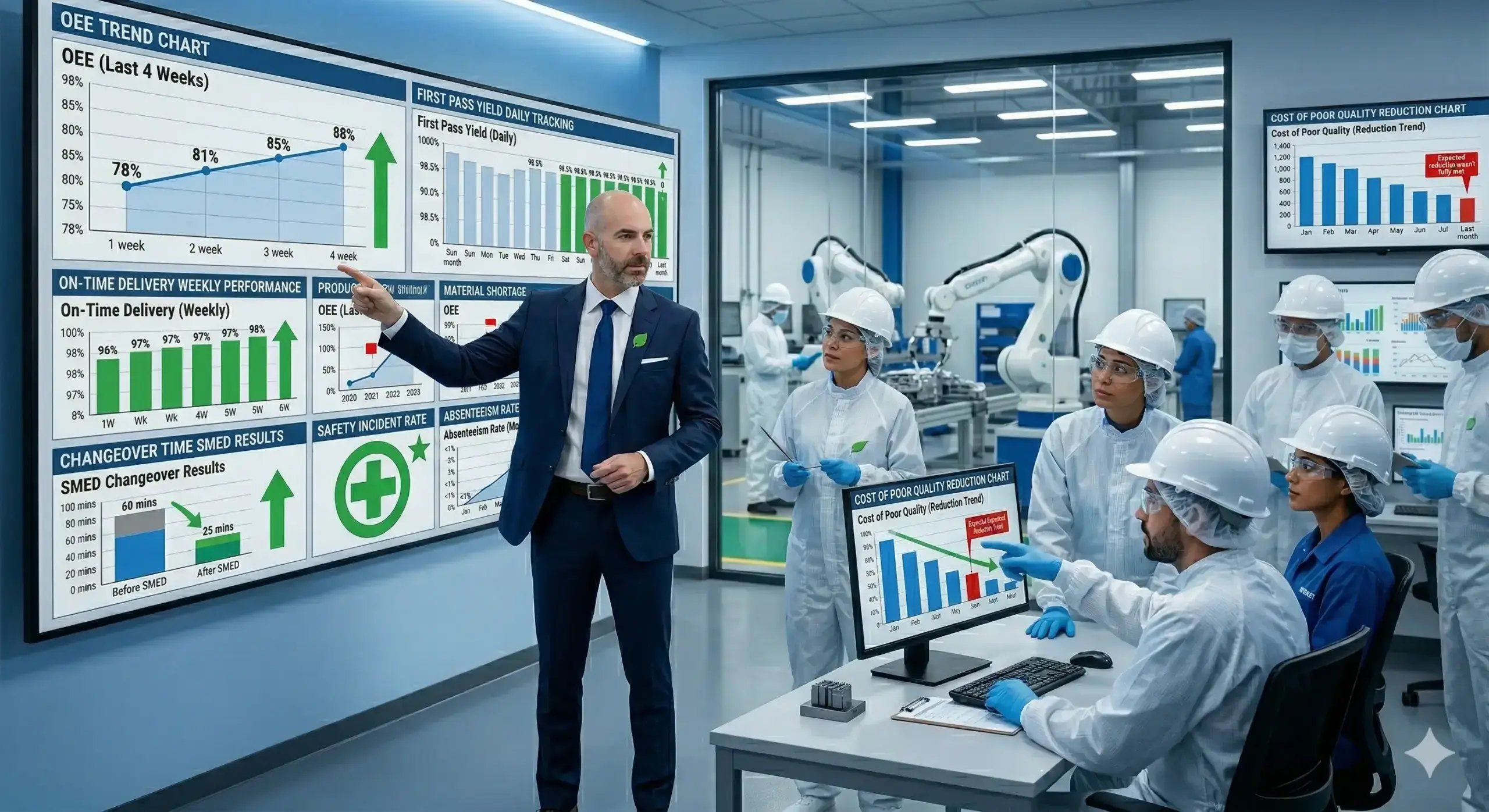
How to Build Your KPI Dashboard
Tracking 7 KPIs sounds complex. In practice, it requires three things:
- A simple daily data collection routine:
Assign clear ownership for each KPI.
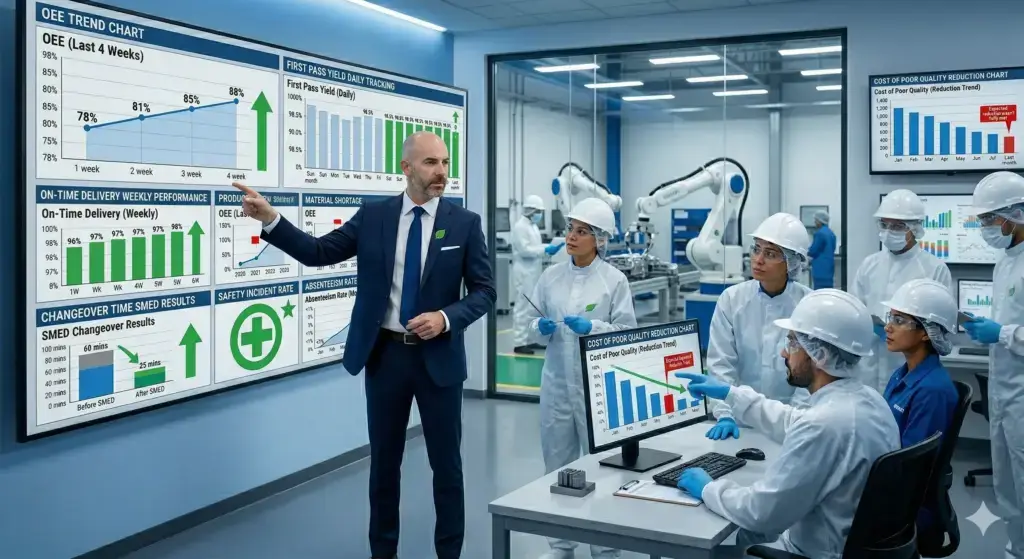
Someone must be responsible for collecting and recording each number every day. - A visual management board:
Post your KPIs visibly on the shop floor.
A number that nobody sees does not drive behavior.
A number displayed publicly and reviewed daily creates accountability. - A daily performance review:
10 minutes every morning.
Yesterday’s numbers. Today’s priorities.
Who owns what? What action is needed?
This routine, consistently applied, transforms a production floor from reactive to proactive within 90 days.
Need Help Building Your KPI System?
I design and implement KPI systems for production operations from defining the right metrics to building visual dashboards and establishing daily review routines.
If your team is making decisions without data or drowning in data without insight, let’s talk.