
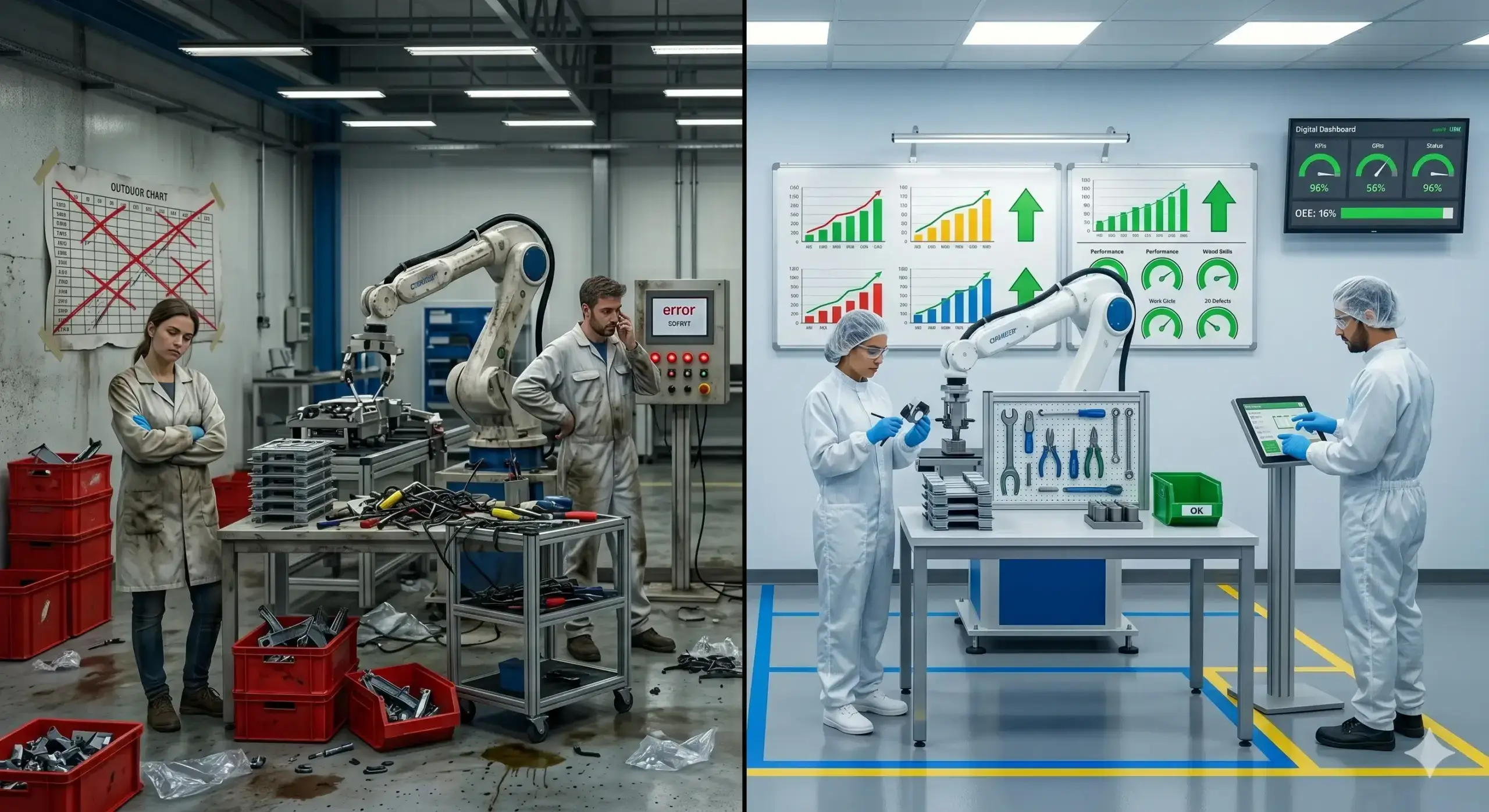

A Lean Approach for Manufacturing Managers
Every manufacturing manager faces the same pressure: Do more with less.
Cut costs. Maintain quality. Increase output. Meet customer deadlines. Keep the team motivated.
The problem is that most cost-reduction programs attack the wrong targets: cutting headcount, reducing training budgets, and delaying maintenance, which end up creating quality problems that cost far more to fix than the savings they generate.
After 23+ years working in production environments across automotive Tier 1 and industrial manufacturing, I’ve learned that the most powerful cost reductions don’t come from cutting resources. They come from eliminating waste.
Here’s how to do it systematically.
Why Traditional Cost Cutting Fails
Traditional cost reduction programs follow a predictable and dangerous pattern:
Step 1: Management sets an arbitrary cost reduction target
Step 2: Departments cut whatever is easiest to cut
Step 3: Quality problems emerge within 90 days
Step 4: Emergency spending exceeds original savings
Step 5: The cycle repeats the following year
The fundamental error is treating cost as the problem. Cost is not the problem. Waste is the problem.
When you eliminate waste, costs naturally fall without compromising quality, safety, or people.
The 7 Wastes of Lean Manufacturing
Lean manufacturing identifies 7 categories of waste that exist in every production environment:
- Overproduction
Producing more than the customer needs, faster than needed.
This is considered the most dangerous waste because it generates all other wastes. - Waiting
Operators waiting for materials, instructions, machine repairs, or quality approval.
Every minute of waiting is a minute of paid labor producing zero value. - Transportation
Unnecessary movement of materials, products, or information between locations.
Transportation adds cost and risk without adding value. - Overprocessing
Doing more work on a product than the customer requires or will pay for.
Gold-plating a product the customer doesn’t need is a waste, even if the work is done perfectly. - Inventory
Excess raw materials, work-in-progress, or finished goods sitting in storage.
Every item in inventory represents capital tied up, space consumed, and risk of obsolescence or damage. - Motion
Unnecessary movement of operators, reaching, walking, searching, and bending.
Poor workstation design forces operators to spend significant time on motions that produce nothing. - Defects
Products that fail to meet quality requirements and require rework, repair, or disposal.
Defects are the most visible waste and often the most expensive.
The eighth waste, underutilized talent: Not engaging the knowledge and creativity of your workforce is perhaps the most costly waste of all.
5 Proven Lean Strategies to Reduce Costs
Strategy 1: Value Stream Mapping
- Map every step in your production process from raw material to finished product.
- Identify which steps add value and which don’t.
- In most facilities, less than 30% of total process time actually adds value.
- The remaining 70% is waste waiting to be eliminated.
Strategy 2: Pull production system
- Stop producing to a forecast. Start producing to actual customer demand.
- A pull system eliminates overproduction, the most destructive waste, and dramatically reduces work-in-progress inventory.
Strategy 3: Standardized work
- Define the one best way to perform every task.
- Document it. Train to it. Audit compliance.
- Standardized work eliminates variation, and variation is the root cause of most quality problems and efficiency losses.
Strategy 4: Preventive maintenance
- Unplanned machine breakdowns are extremely costly, resulting in lost production, emergency repairs, overtime, and missed deliveries.
- A structured preventive maintenance program eliminates most unplanned downtime at a fraction of the cost of reactive maintenance.
Strategy 5: Error proofing (Poka-Yoke)
- Design your processes so that mistakes are impossible or immediately detectable.
- Every defect that reaches the customer costs 10 times more to fix than one caught at the source.
- Poka-yoke devices prevent defects from occurring in the first place.
Real Results From Lean Cost Reduction
In my consulting practice, applying these strategies consistently delivers:
✅ 15-30% reduction in production costs within 6-12 months
✅ 20-40% reduction in defect rates
✅ 25-50% reduction in changeover time
✅ 10-30% improvement in on-time delivery
✅ Significant inventory reduction typically 20-40%
These are not theoretical numbers. They are results achieved in real facilities, with real teams, facing real constraints.
Where to Start`
The most common mistake is trying to implement everything at once.
Start here:
Week 1:
- Walk your production floor and identify the single biggest source of visible waste.
- Don’t analyze. Don’t build a committee.
- Just observe and document.
Week 2:
- Quantify the cost of that waste.
- How much time? How much material?
- How many people? What is the €/month impact?
Week 3:
- Design a simple countermeasure.
- What is the smallest change that would eliminate or significantly reduce this waste?
Week 4:
- Implement, measure and communicate results.
Eliminating one waste per month, sustained and built upon, transforms a production facility within 12 months.
The key is starting. Today.
Ready to Reduce Your Production Costs?
I work with production teams to identify, quantify, and systematically eliminate waste, delivering measurable cost reductions without touching quality, safety, or team morale.
Let’s discuss your specific situation.