

- The Hidden Reason Behind Failed Certifications
- What ISO 9001 Actually Requires
- The 5 Most Common Training Failures in ISO 9001
- What Effective ISO 9001 Training Looks Like
- The Real Sign Your QMS Training Is Working
- How to Fix Your ISO 9001 Training Program
- Need Help Building Your ISO 9001 Training Program?
The Hidden Reason Behind Failed Certifications
Every year, thousands of organizations invest significant time and money pursuing ISO 9001 certification.
And every year, a significant number of them either fail their audit, achieve certification only to lose it within 2 years, or, worse, get certified on paper while quality problems continue to multiply on the shop floor.
The reason is almost always the same.

It’s not the processes. It’s not the documentation. It’s not even the auditor. It’s the people.
After participating in numerous organizational audits within the frameworks of ISO 9001 and IATF 16949, one conclusion is unequivocal: a quality management system is only as robust as the people who operate it day to day.
Here’s why training is the make-or-break factor.
What ISO 9001 Actually Requires
ISO 9001:2015 dedicates an entire clause — Clause 7.2 — specifically to competence.
The standard requires organizations to:
- Determine the necessary competence of people doing work that affects quality performance
- Ensure people are competent based on education, training or experience
- Take action to acquire the necessary competence
- Retain documented evidence of competence
This is not optional language. This is a mandatory requirement that auditors will test directly.
Yet in my experience, it is the clause most organizations address last and least seriously.
The 5 Most Common Training Failures in ISO 9001
- Training that happens only before the audit. The most dangerous approach. Teams are briefed on procedures days before the certification audit, retain almost nothing, and revert to old habits immediately after the auditor leaves.
- Training that covers documents, but not understanding: operators can recite a procedure, but don’t understand why it exists. When something unexpected happens, and it always does, they have no framework to respond correctly.
- Training that stops at the management level. Quality is made on the shop floor, not in the boardroom. If operators and team leaders don’t understand their role in the QMS, the system exists only on paper.
- No verification of training effectiveness. Organizations record that training happened. They rarely verify that learning occurred. These are two completely different things.
- No refresher training program, ISO 9001 requires ongoing competence. A one-time training event 3 years ago does not meet the requirements of a dynamic quality system.
What Effective ISO 9001 Training Looks Like
After helping organizations achieve and maintain ISO 9001 certification, I’ve identified the key elements of training that actually works:
✅ Role-specific training
Not everyone needs to know everything. Operators need to understand their specific procedures and quality controls.
Team leaders need non-conformance management. Management needs process performance and strategic quality objectives.
✅ Practical, not theoretical
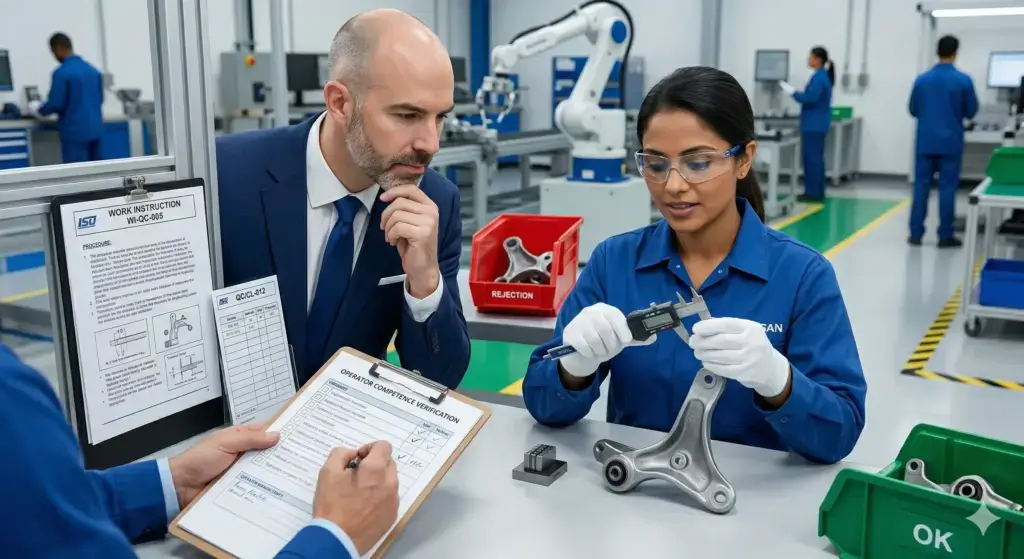
Training must be conducted at the workstation, with real documents and real scenarios. Classroom theory without shop floor application
produces compliance actors, not quality thinkers.
✅ Competence verification
After training, verify understanding through practical assessment, not multiple-choice tests. Ask the operator to demonstrate the procedure.
Ask them what they do when the product is out of specification.
✅ Documented evidence
Keep training records that include what was trained, who delivered it, when it occurred, and how competence was verified.
This is what auditors want to see.
✅ Ongoing refresher program
Build a quarterly refresher schedule into your QMS. Refresh key topics, address recurring non-conformances, and update training when procedures change.
The Real Sign Your QMS Training Is Working
You don’t need an auditor to tell you whether your training is working.
Walk your shop floor and ask three operators these questions:
- What are the quality controls at your workstation?
- What do you do if you find a non-conforming product?
- What is your role in achieving our quality objectives?
If they answer confidently and correctly, your training is working.
If they look uncertain, give inconsistent answers, or say “I’m not sure, ask my supervisor,” you have a training gap that will cost you
in your next audit.
How to Fix Your ISO 9001 Training Program
Start with a training needs analysis:
- Map every role that affects product quality
- Identify required competencies for each role
- Assess current competence against requirements
- Build a targeted training plan to close gaps
- Implement, verify and document
This is not a one-week project. It is an ongoing management commitment.
But the organizations that get this right don’t just pass their ISO 9001 audit. They build a quality culture that reduces defects, improves customer satisfaction, and creates a competitive advantage that no certificate alone can deliver.
Need Help Building Your ISO 9001 Training Program?
I design and deliver role-specific ISO 9001 and IATF 16949 training programs that prepare your entire organization, from operators
to management for successful certification and sustainable quality performance.
Let’s discuss your current situation.