
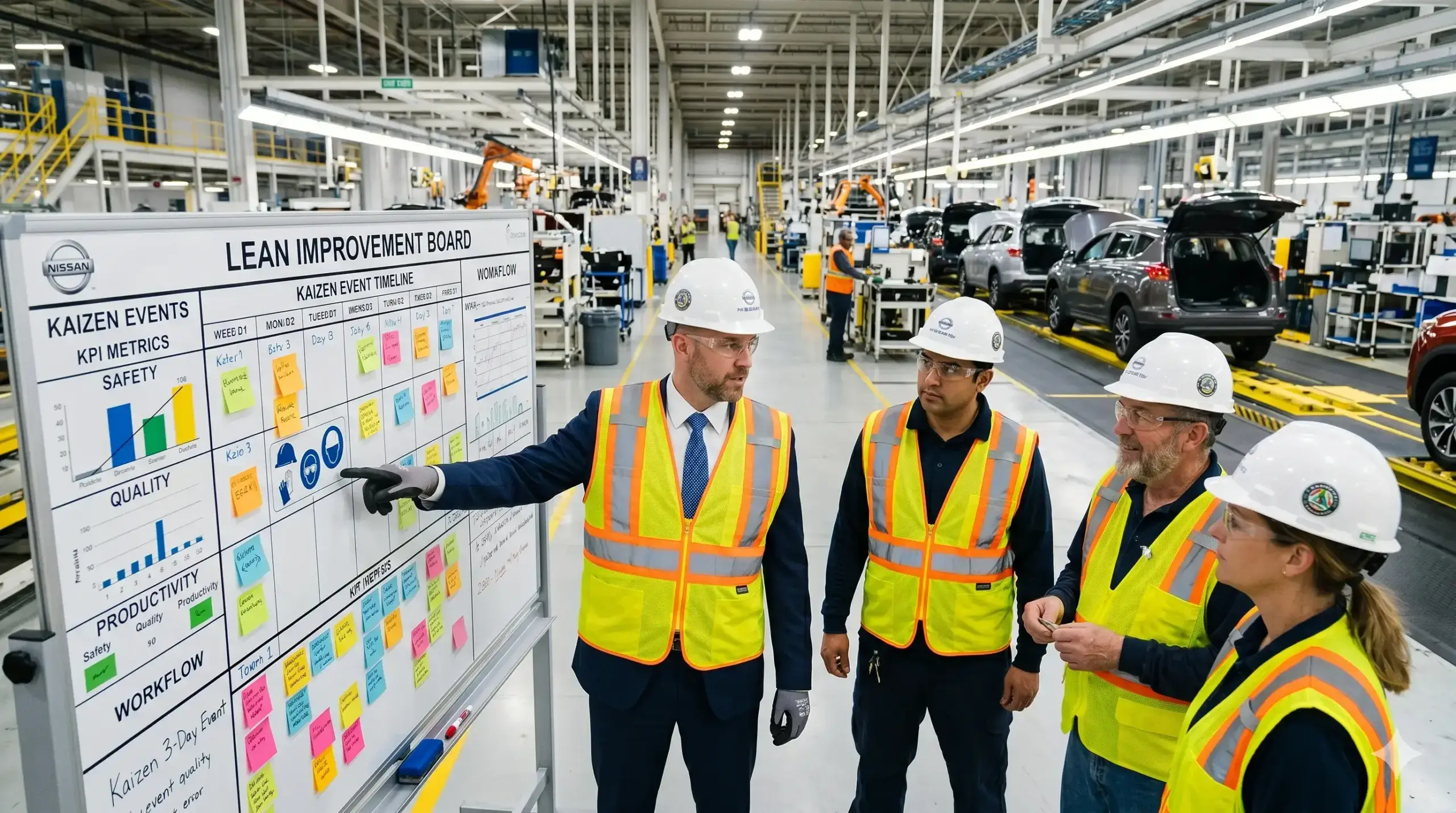
Introduction
If you have ever walked a factory floor and noticed small inefficiencies that nobody seems to fix, a cluttered workstation, a recurring minor stoppage, a manual step that takes twice as long as it should, you have already identified the problem that Kaizen was designed to solve.
Kaizen is a Japanese philosophy that means change for the better. In manufacturing, it translates into a structured, people-driven approach to continuous improvement. It is not about big transformation projects or expensive technology. It is about small, daily improvements made by the people who do the work.
With over 23 years of experience in operations. The principle is always the same: engage your people, target waste, measure results, and sustain the gains.
📊 Industry Data
Research by Industry Week shows that companies sustaining Lean practices for 3+ years outperform industry peers by 2–3x on productivity growth.
A study by the Lean Enterprise Institute found that Lean transformations reduce manufacturing lead times by an average of 50% within the first 12 months.
What Is Kaizen and Why It Matters in Manufacturing
Kaizen originated in Japan after World War II, heavily influenced by American quality experts like W. Edwards Deming and Joseph Juran. Toyota adopted it as a core pillar of the Toyota Production System (TPS), and from there it spread globally.
In manufacturing, Kaizen matters because no process is perfect from day one. Equipment degrades, customer requirements evolve, and what worked last year may be inefficient today. Without a structured improvement mindset, plants stagnate, costs creep up, quality drifts, and competitors gain ground.
Key benefits of Kaizen in manufacturing:
- Reduction of non-value-adding activities (waste)
- Improved product quality and consistency
- Higher employee engagement and ownership
- Faster response to production problems
- Lower operational costs without capital investment
The 5 Core Principles of Kaizen
Before launching any Kaizen activity, every team member should understand these five principles:
1. Know your customer. Every process exists to deliver value to the next step, whether that is an internal customer (the next workstation) or the final customer.
2. Let it flow. The goal is smooth, uninterrupted flow of materials and information. Any interruption is a signal to improve.
3. Go to the Gemba. Gemba means the real place, the shop floor where the work happens. Improvement decisions must be made based on direct observation, not office assumptions.
4. Empower people. The operators closest to the process have the best insight into its problems. Kaizen only works when their ideas are valued and acted upon.
5. Be transparent. Make problems, targets, and results visible to everyone. Hidden problems cannot be solved.
How to Launch Your First Kaizen Event
A Kaizen event (also called a Kaizen blitz) is a focused, short-term improvement activity targeting a specific process or problem. Here is how to run one:
Step 1 – Define the scope:
Choose one specific area or process to improve. Avoid trying to fix everything at once.
Step 2 – Set a clear goal:
Define what success looks like before you start. Example: reduce changeover time by 30%.
Step 3 – Select your team:
A Kaizen team of 4 to 8 people works best. Include operators, a supervisor, a quality or maintenance rep, and a lean facilitator.
Step 4 – Observe and measure the current state:
Spend the first day on the floor. Time the process, count the steps, and observe the waste.
Step 5 – Brainstorm and implement improvements:
Generate ideas as a team, prioritize by impact and ease, and begin making changes immediately.
Step 6 – Measure the results:
Compare the new process against your baseline and document what improved.
Step 7 – Standardize and sustain:
Update work instructions, train the team, and implement visual controls.
Roles: Who Leads and Who Participates
Executive sponsor: A plant manager or operations director who authorizes resources and visibly supports the initiative.
Kaizen facilitator: An experienced lean practitioner who guides the team through the methodology and coaches problem-solving techniques.
Team leader / supervisor: The area owner who ensures the team has access, information, and authority to make changes.
Operators: The people who perform the work every day. Their knowledge of the process is irreplaceable.
Support functions: Quality, maintenance, and engineering may be needed for technical changes or safety compliance.
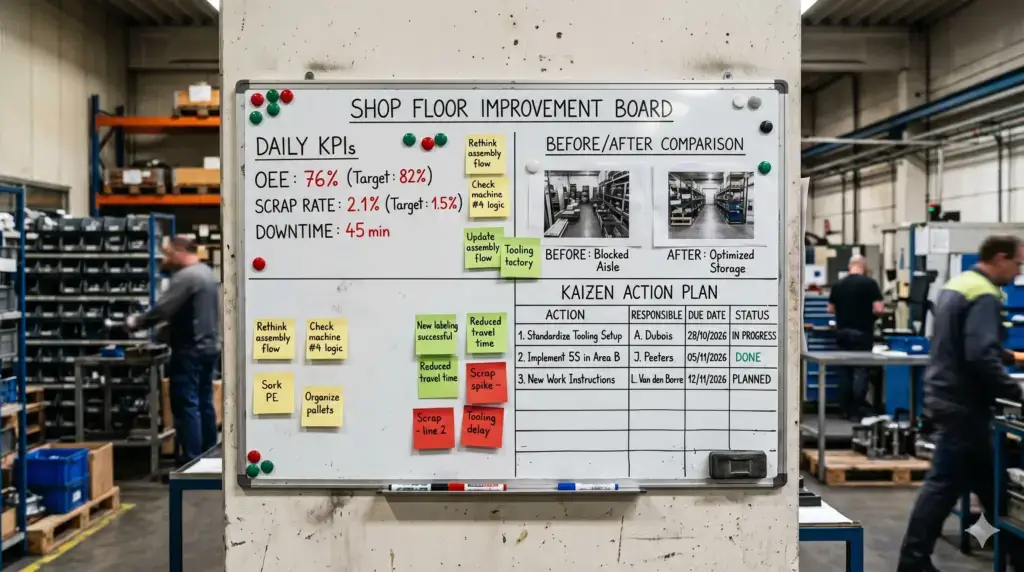
Measuring Kaizen Results with KPIs
Every Kaizen event must be measured. Without data, you cannot confirm the improvement worked or sustain it over time.
| KPI | Baseline | Target | Result |
| Cycle time | 48 sec | 38 sec | — |
| Defect rate | 2.8% | 1.0% | — |
| Changeover time | 42 min | 28 min | — |
| Distance traveled (operator) | 18 m/cycle | 8 m/cycle | — |
| Suggestions per month | 2 | 10 | — |
Track results for 30, 60, and 90 days after the event to confirm that improvements are sustained.
Common Mistakes and How to Avoid Them
Mistake 1 – Treating Kaizen as a one-time event:
Kaizen is not a project with an end date. It is a culture. One event changes nothing permanently.
Mistake 2 – Excluding operators:
Improvement designed by managers and imposed on operators fails. Always involve the people doing the work.
Mistake 3 – No follow-up:
Many Kaizen events lose their gains by month two because nobody checks. Assign clear ownership for each improvement.
Mistake 4 – Ignoring small ideas:
Not every improvement needs a formal event. A suggestion box or daily team huddle captures hundreds of small improvements per year.
Mistake 5 – Starting too big:
Your first event should target a small, visible, winnable problem. An early success builds credibility and momentum.
Conclusion and Next Steps
Kaizen is one of the most powerful and accessible improvement tools available to manufacturing leaders. It does not require large budgets, complex technology, or external consultants. It requires commitment, structure, and respect for the people on the floor.
Start small. Pick one problem. Build a team. Measure the result. Then do it again.