
How to Build a Culture of Continuous Improvement
In Japanese, Kaizen means “change for the better.”
In manufacturing, it means something far more powerful: a daily commitment by every person in the organization, from the CEO to the newest operator, to make their work a little bit better today than it was yesterday.
Organizations that master Kaizen don’t just improve. They build a self-sustaining improvement engine that generates competitive advantage year after year.
After implementing Kaizen programs in manufacturing facilities, I’ve seen firsthand the transformation it delivers and the mistakes that prevent most organizations from achieving it.
Here is everything you need to know.
What Kaizen Is? and What It Is Not?
Kaizen IS:
✅ Small, daily improvements made by everyone
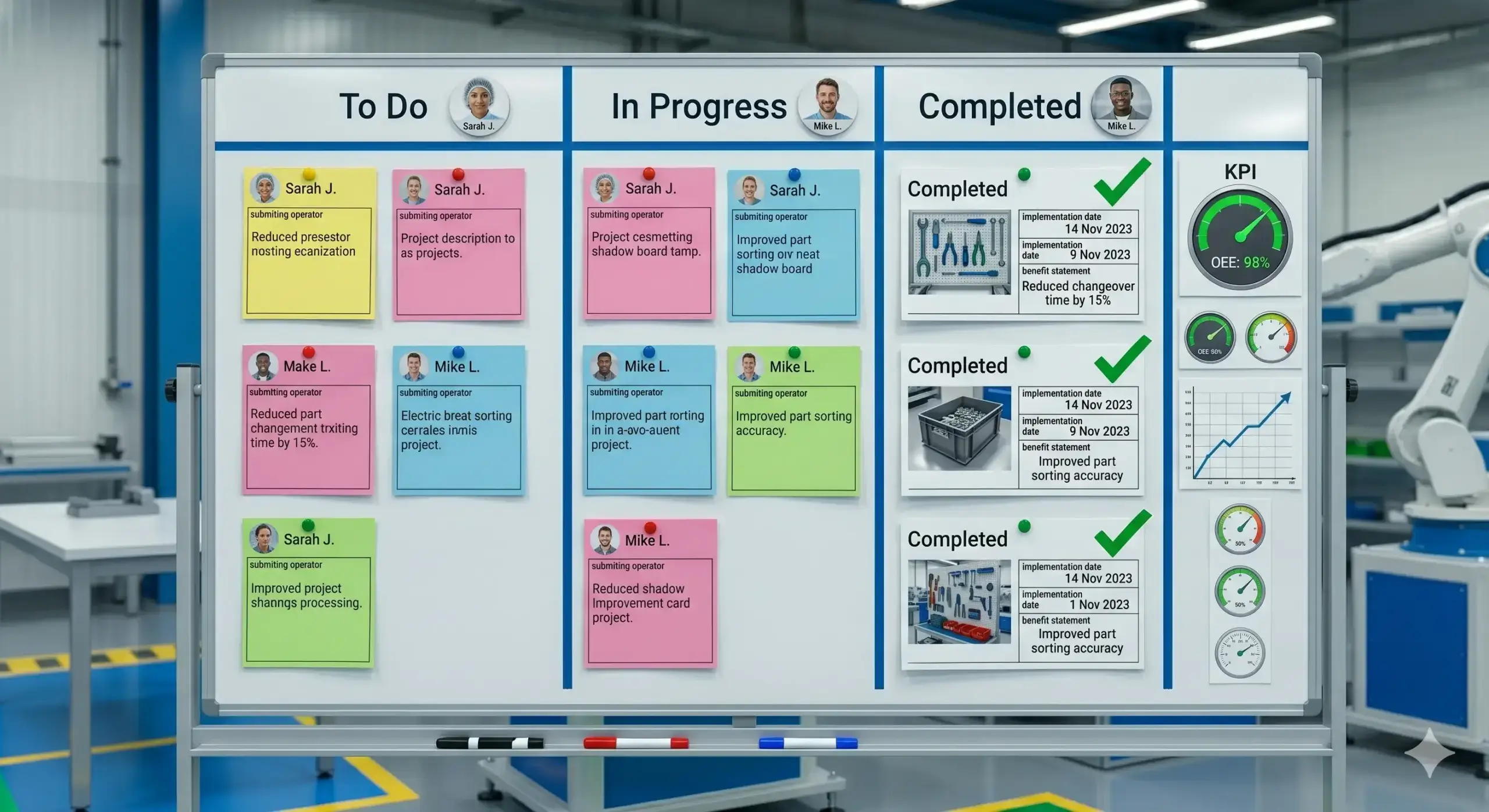
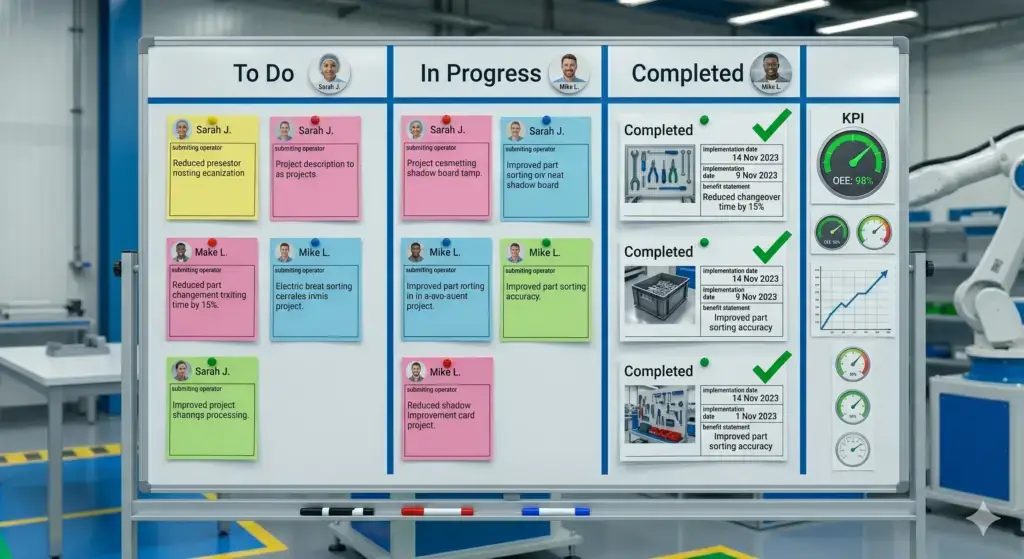
✅ A structured system for capturing and implementing improvement ideas
✅ A management philosophy that values frontline knowledge
✅ A long-term commitment to excellence
✅ Sustainable competitive advantage
Kaizen is NOT:
❌ A one-time improvement event
❌ A management-only initiative
❌ A cost-cutting program
❌ A quick fix for deep operational problems
❌ Something that can be delegated to a committee
The most important distinction: Kaizen is not something you DO. It is something you BECOME.
The 4 Pillars of a Successful Kaizen Program
Pillar 1: Leadership commitment
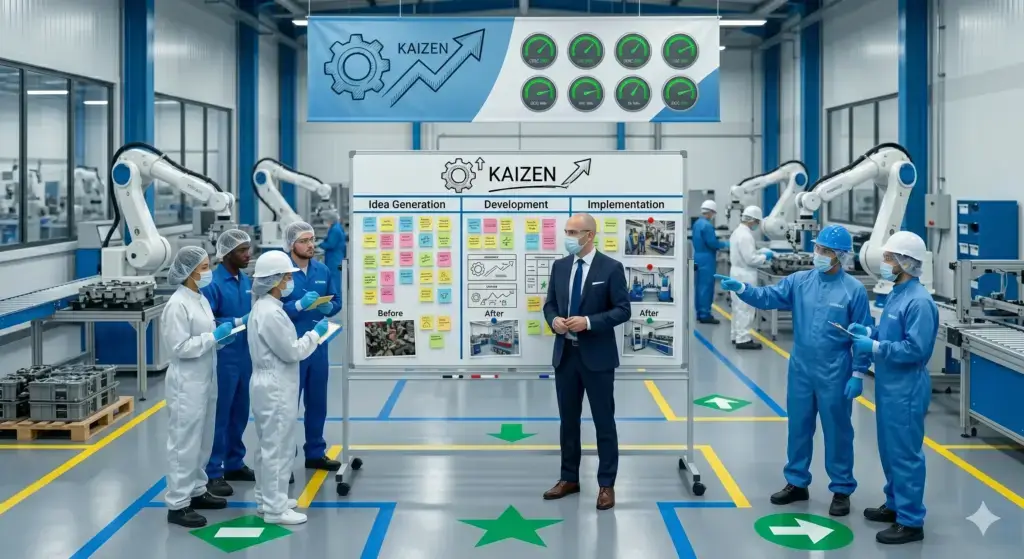
Kaizen cannot be delegated. If senior management doesn’t walk the floor, ask improvement questions, and visibly support the program, it will die within 90 days.
Leadership commitment means:
- Conducting weekly GEMBA walks
- Reviewing improvement ideas personally
- Implementing suggestions visibly and quickly
- Recognizing and rewarding improvement behavior
Pillar 2: Simple idea capture system
Most improvement ideas die because there is no easy way to capture them.
The system must be:
- Simple enough to complete in 2 minutes
- Visible and accessible at every workstation
- Reviewed within 24 hours of submission
- Responded to within 7 days, even if the answer is “not now, because…”
Pillar 3: Fast implementation
The number one killer of Kaizen culture is a slow response to improvement ideas.
When an operator submits an idea and sees nothing happen for 3 months, they never submit another idea.
Aim to implement 50% of ideas within 2 weeks.
Pillar 4: Visible recognition
People improve what gets recognized.
Post improvement results publicly.
Celebrate the operator who found the solution as loudly as you celebrate the production record.
How to Launch a Kaizen Program in 6 Steps
Step 1: Establish the Kaizen team
Identify a Kaizen coordinator, typically a team leader or process engineer.
This person is responsible for tracking, prioritizing, and facilitating the implementation of improvement ideas.
Step 2: Design your idea capture system
Create a simple one-page improvement idea form:
- What is the current problem?
- What is the proposed improvement?
- What is the expected benefit?
- Who raised it? (optional, some prefer anonymous)
Post the form at every workstation.
Step 3: Train everyone
Conduct a 30-minute Kaizen awareness session for all operators and team leaders.
Explain what Kaizen is, how to submit ideas, and what happens after submission.
Step 4: Launch with a Kaizen event
Select one area with a known, visible problem.
Run a focused 3-5 day improvement event with a cross-functional team.
Implement changes immediately.
Communicate results to the entire facility.
Step 5: Establish the review rhythm
Weekly: Kaizen coordinator reviews new ideas
Monthly: Management reviews program metrics
Quarterly: Recognition event for top contributors
Step 6: Track and communicate results
Monthly KPIs for your Kaizen program:
- Number of ideas submitted
- Number of ideas implemented
- Implementation rate (target: above 70%)
- Average implementation time (target: under 14 days)
- Cost savings generated
Common Kaizen Mistakes to Avoid
Mistake 1: Waiting for big ideas
Kaizen is not about revolutionary breakthroughs. It is about thousands of small improvements that compound over time.
Train your team to think small; the smallest ideas are often the most valuable.
Mistake 2: Ignoring submitted ideas
Every ignored idea sends a message: “Your contribution doesn’t matter here.” Even if an idea cannot be implemented, explain why and thank the contributor.
Mistake 3: Stopping after the first event
A Kaizen event is a catalyst, not a destination.
The real work is building the daily habit that sustains improvement between events.
Mistake 4: Measuring inputs instead of outcomes
Counting the number of ideas submitted is meaningless if they are not implemented.
Measure implementation rate and value generated not submission volume.
What Kaizen Delivers After 12 Months
Organizations that implement Kaizen correctly and consistently typically achieve:
✅ 50-200+ improvement ideas implemented per year
✅ 15-25% reduction in process waste
✅ Significant improvement in operator engagement
✅ Measurable reduction in quality defects
✅ A shop floor culture that management no longer needs to drive; it drives itself
The compounding effect of daily improvement is the most powerful force in manufacturing.
One improvement per day, per team, sustained for 12 months, transforms a facility beyond recognition.
Ready to Build a Kaizen Culture?
I design and implement Kaizen programs for manufacturing teams, from launching the idea system to training leaders and building the management routines that sustain them.
Let’s build your improvement culture together.