
INTRODUCTION
Aziz Bamar spent 23 years running manufacturing plant floors. He led production teams, built production processes, quality, and safety systems from the ground up, managed lean transformations at automotive Tier 1 suppliers and glass processors, and trained hundreds of operators and team leaders.
📊 Industry Data
Research by Industry Week shows that companies sustaining Lean practices for 3+ years outperform industry peers by 2–3x on productivity growth.
According to McKinsey & Company, manufacturers that implement Lean systematically reduce operational costs by 15–25% and improve on-time delivery by up to 40%.
Now he runs Mitiga Consulting independently. He applies the shop-floor discipline he learned in 23+ years to help organizations improve operations without the expense of hiring a large consulting firm.
We talked with Aziz about lean manufacturing: which tools actually work, why some plants improve while others plateau, and what mindset makes the difference.
Question 1
Aziz, you’ve spent 23 years working in manufacturing plants. What’s something that experience has taught you that textbooks just can’t?
The textbook teaches you the what. The factory floor teaches you why it fails.
I can tell you the exact steps of a Kaizen event. But I couldn’t learn from a book what happens when an experienced operator looks at you during a brainstorming session, says nothing, and folds their arms. That silence tells you everything. It means the team doesn’t believe this improvement will stick after you leave. That’s the difference between a Kaizen that works and one that becomes a case study.
Twenty-three years taught me that every operational problem has a technical side and a human side. Most consultants and most textbooks focus on just the technical side. The human side is where things work or fail. I learned to read both.
Question 2
Start with Kaizen, it’s the foundation. You call it a philosophy rather than a tool. What’s the difference, and why does it matter?
When organizations treat Kaizen as a tool, they schedule events, measure the results, post them on a board, and move on. The board gets dusty. The gains erode. Six months later, they run another event in the same area and wonder why the same problems are back.
When they treat it as a philosophy, they stop asking when the next Kaizen event is. They ask what we’re improving today. That’s the shift, from Kaizen as a scheduled activity to Kaizen as normal work, and it separates plants that sustain improvement from those that run programs and move on.
The distinction matters because it changes what leaders invest in. A tool needs a budget for events. A philosophy needs a culture of daily observation, small ideas, and leaders who show up. The second costs more upfront but delivers more value.
Question 3
Most manufacturing professionals have heard of Value Stream Mapping, but struggle with it. Where do most organizations go wrong?
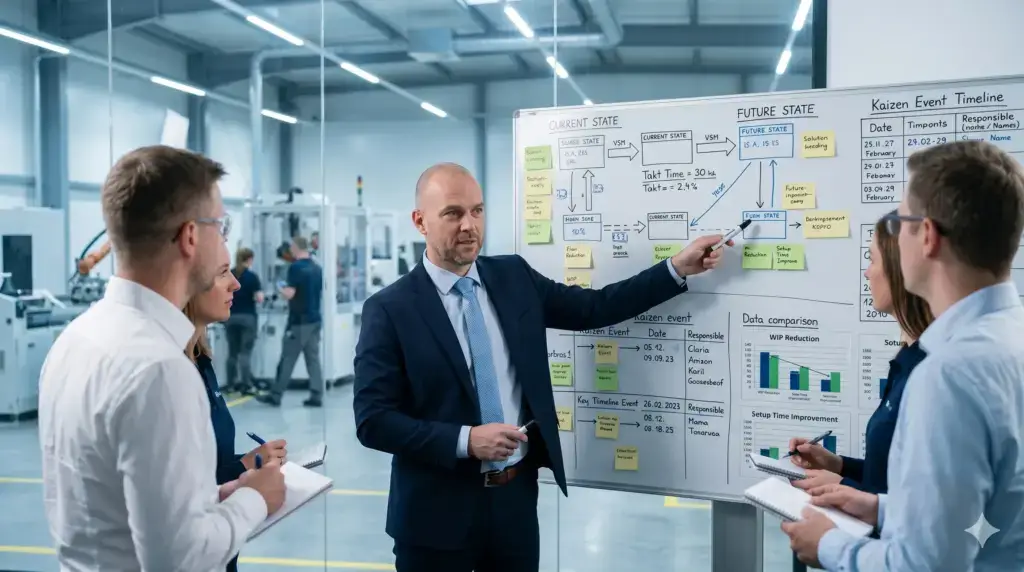
Three consistent mistakes. First, they map how the process is supposed to work, not how it actually works. You end up with a beautiful diagram of something that doesn’t exist. When I run a VSM exercise, I insist that everyone walks the floor and watches every step. The gap between what’s documented and what actually happens is where the waste is.
Second, they create the current state map and stop. It ends up on a conference room wall, management calls it a success, and nothing changes. Without a future state and an action plan with real deadlines, VSM is just a diagnosis without treatment.
Third, they try to map everything at once. VSM works best at the product family level, a set of products that follow similar process steps. When you map your entire operation, the diagram becomes too complex to be useful. Start with your highest-volume product family. Map it in a day. Use it.
Question 4
FMEA is supposed to be a powerful quality tool, but it’s often hated in manufacturing. Why? And how do you actually make it work?
FMEA gets hated because most teams treat it as a paperwork exercise rather than a thinking exercise. You lock in a cross-functional team, have someone copy failure modes from last year’s spreadsheet, negotiate the RPN scores down until they’re acceptable, and submit the document. Nothing actually changes. People don’t believe any of it was worth their time. The hatred makes sense.
FMEA works when a team is really asking, “How could this process harm our customer?” When that question drives real changes, such as process improvements, new controls, or additional validation, FMEA actually means something. The document just records what you thought. The thinking is what matters.
What I do differently: I always start by asking the team to bring their three worst quality escapes from the past year. We go through the FMEA for each one and ask why we didn’t catch this. That conversation, done honestly, creates commitment that no training class ever could. The team immediately sees that the tool matters because it connects to real problems they have lived through.
Question 5
OEE (Overall Equipment Effectiveness) is a metric almost every manufacturing plant tracks. Yet most plants that track it don’t improve it much. What’s the gap between measuring OEE and actually using it?
The gap is almost always in the daily management routine, not the measurement system.
I’ve visited plants with sophisticated digital OEE dashboards (real-time data, color-coded displays, automated alerts) where OEE hasn’t moved in eighteen months. I’ve also visited plants with a simple paper chart updated by hand at the end of each shift, where OEE improved twelve points in six months. The difference isn’t the technology. It’s whether the team reviews the data every day, discusses what caused the losses, and assigns specific actions to specific owners.
OEE is a window. It shows you exactly where time is being lost: availability, performance, or quality. But if nobody looks through the window and acts on what they see, the window is irrelevant.
The plants that improve OEE build a daily discipline around reviewing the previous shift’s losses and deciding what to change today. That discipline is a leadership habit, not a technology investment.
Question 6
You work with organizations across different industries and sizes. Is there a single most common mistake you see manufacturing leaders make, regardless of the sector or scale?
Yes. They solve problems instead of building their team’s capability to solve them.
A plant manager who is genuinely brilliant at diagnosing and fixing operational problems creates a plant that performs well when they are present and struggles when they are not. They have built dependency rather than capability. And because they spend all their time solving today’s problems, they have no time to think about next month’s.
The most impactful shift a manufacturing leader can make is to move from answering questions to asking them. It’s also the hardest. Instead of “here is what you should do,” the question becomes: what options do you see, and which would you try first? That question takes twice as long in the moment and builds capability that compounds over the years. The leaders who make that shift produce the best plants. It’s not their own brilliance that matters. It’s that they’ve taught their teams how to think.
Question 7
Lean transformations have a notoriously high failure rate. Some estimates put it at 70% or higher. In your experience, what actually causes lean initiatives to fail, and what does a successful one look like?
Lean initiatives fail for one reason more than any other: the organization treated lean as a program rather than as a management system.
A program has a start date, a project team, a set of tools to implement, and an expected completion date. When the program ends, the gains begin to erode. The consulting contract finishes. The internal project team dissolves. The executive champion moves on. The organization’s underlying management system never changed. How decisions get made, how problems surface, and how performance gets reviewed all stayed the same. The lean tools were grafted onto the old system. They did not survive the graft.
A successful lean transformation looks fundamentally different. It starts with leadership behavior. Leaders need to go to the floor regularly, review real data honestly, and respond to problems through root cause analysis rather than blaming people. When that behavior stays consistent, the culture shifts. The tools become expressions of the culture instead of replacements for it.
I have seen plants that did everything right technically. They had all the standard tools: VSM, Kaizen events, 5S, SMED. Yet they still failed because the plant manager’s response to a crisis was always to find someone to blame and issue a directive. And I have seen plants with modest technical implementations produce extraordinary results. The leadership created genuine psychological safety and an honest daily review. The human infrastructure is what matters.
Question 8
A plant manager wants to improve operations but doesn’t know where to start. What do you tell them to do first?
Walk your floor for two hours without an agenda and without your phone.
Don’t inspect. Don’t check compliance. Just watch. Watch what actually happens. Notice where people wait. Notice where materials pile up. Notice the workarounds people built because the official process doesn’t work. Notice where people look stressed and where work flows easily.
After two hours, you’ll have five to ten things that need attention. You found them by watching, not from reports or benchmark studies. That’s your starting point.
Pick the single most visible, most impactful problem from that list. Build a small team. Map the current state. Set a specific improvement target. Run a focused event. Measure the result. Post it on the wall.
That first improvement, done well, measured honestly, and shared openly, does more for your improvement culture than any training program. It proves change is possible. It shows your team’s ideas matter. It shows you actually listen. Everything else builds on that.
Question 9
Your blog focuses on how mindset and lean practices work together. Do you think mindset is really as important as the actual methodology when it comes to manufacturing excellence?
Every methodology works in some organizations and fails in others. Same tools, same training, same support. What matters is the leader’s mindset.
A fixed-mindset leader thinks the plant runs at nearly full capacity. He sees inevitable problems. The team is about as capable as it’s going to get. Improvement initiatives become compliance exercises, something forced on them until they go away.
A growth mindset leader believes the plant has far more potential. He sees opportunities not yet addressed. The team hasn’t reached its real capability. Every lean tool is a real investment because it is expected to return.
I’ve watched the same VSM exercise transform one plant and produce a neat filing cabinet in another. Same method. Different mindset.
Question 10
Finally, what does manufacturing excellence look like in practice? Forget the metrics and certifications. What does it feel like to walk into a plant that runs well?
You notice it before you see any data.
The floor is orderly without being sterile. You know where everything belongs and can immediately spot if something is out of place. People make eye contact and look engaged, not anxious. Team leaders move with purpose, not urgency. Activity without chaos.
Then you look at the management boards. The SQCD board was updated today. Real numbers, including the red ones. Open actions have names and dates. Not many because they’re being closed. The near-miss log has entries from this week. That means the team feels safe reporting.
You sit in on the daily stand-up. Twelve minutes. The team leader asks questions, operators answer. Yesterday’s problem is discussed without blame. What happened? What caused it? What changed? An action is assigned and acknowledged. The meeting ends.
Nobody in that plant calls what they do ‘lean’. They say: This is just how we run. Excellence here is normal. The standard runs so deep that the practice vanishes from view. This is what manufacturing excellence looks like. It took years to build. It will outlast whoever built it.
That’s what I’m trying to help organizations create.
CLOSING NOTE
Aziz Bamar is an independent operations and QSHE consultant in Belgium. He works with European manufacturing companies on lean implementation, ISO management systems, KPI performance, and leadership development.
If you’re dealing with similar challenges, talk with Aziz directly. He offers a free 30-minute call, no sales pitch, just a real conversation about your operation.
Explore more on this blog:
- How to Implement Kaizen in Manufacturing: A Step-by-Step Guide
- Value Stream Mapping: How to Identify and Eliminate Waste in Your Factory
- OEE Explained: How to Measure and Improve Overall Equipment Effectiveness
- FMEA in Manufacturing: How to Prevent Failures Before They Happen